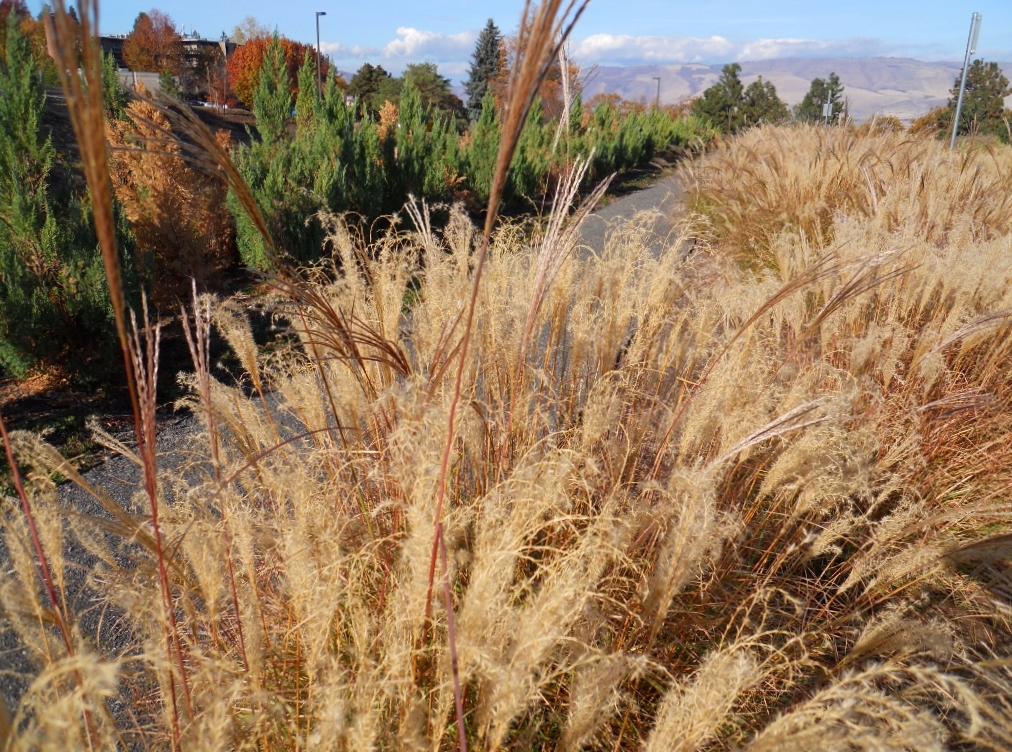
Ornamental grasses strike me as elegant and graceful: swaying mildly in breezes, never clunky; softening hard edges through gentle curves of stem and plume.
Weekly Photo Challenge: Graceful
Taken at The Dalles Readiness Center.

Ornamental grasses strike me as elegant and graceful: swaying mildly in breezes, never clunky; softening hard edges through gentle curves of stem and plume.
Weekly Photo Challenge: Graceful
Taken at The Dalles Readiness Center.
This challenge was a bit difficult for me – only because it was hard to narrow it down. Ben, in his WordPress post, says this about gracefulness: “Gracefulness is a tricky quality — it manifests itself as an effortless, subtle harmony between a subject and its environment.”
I often find this harmony at the beach…in the motion of the waves, for instance, or in the architecture of one of the many bridges or in one of Oregon’s beautiful lighthouses. Finally, though, I settled on this walkway, outside Newport’s Visual Arts Center. Until I read Ben’s post, I didn’t realize that one reason this spot appeals to me is the effortless harmony between the lampposts and the walkway: they are part and parcel of it. 

The rhythm, repetition, and scale of the lampposts, as well as the material from which they are made, fit in perfectly with their location near the ocean, with its own rhythm, repetition, and scale. I want to go back.
Weekly Photo Challenge: Graceful

Ambience is the atmosphere of one’s surrounding environment….Things like light, temperature, smell, sound, and sometimes taste, all work together to create ambience. ~The Daily Post, Jeff Golenski
The grounds at this restaurant create exceptional ambience. Yes, there is warmth and light, but the ocean right at its edge provided instant ambience for me.
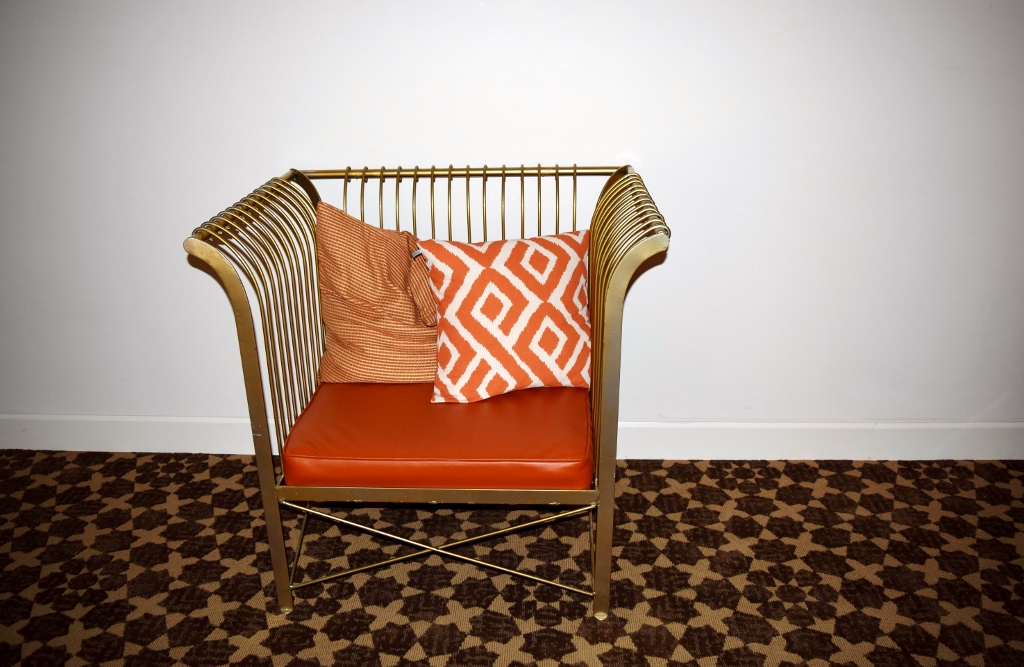
This is my entry for Jennifer Nichole Wells’s Color Your World – Orange Challenge. This is my first entry in her series of challenges.
On a trip to Ashland, Oregon, last summer, I seemed to see orange everywhere.
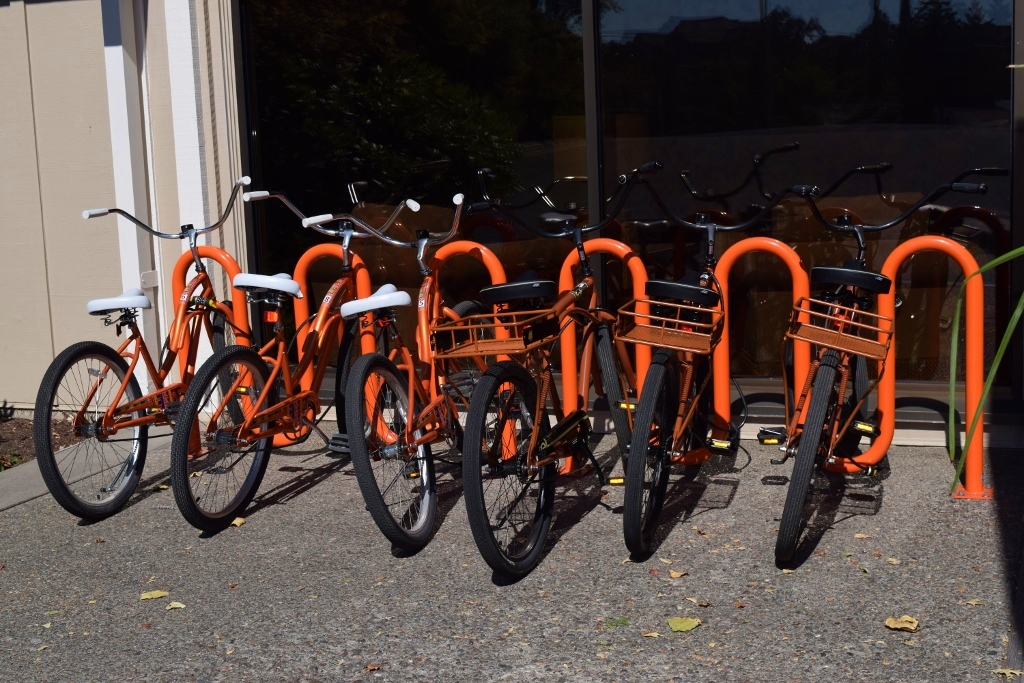
I do love orange; it’s such a happy pop of color!
Have a wonderful weekend!
xoxo
Carol
Found in a yarn shop in Portland:
The challenge:
Humans love naming things — look around you, and I bet you’ll see dozens of names. This week, take a photo of one! The Daily Post, Michelle W.
Check out other challenge entries here: Weekly Photo Challenge: Names.
January 4th is the last day to sign up for our Wuv, Tru Wuv Mini Swap in the Knits Equals Joy Ravelry group! Knitters, we would love to have you come join us!
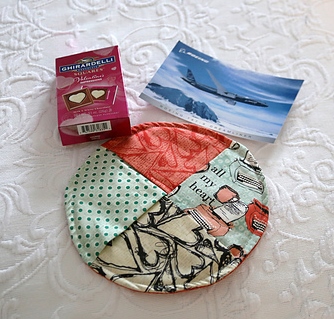
This is a really great way to get to know other knitters, and we always have a lovely time. In this mini-swap you will send one small knit, crocheted, sewn or stitched gift, a card and a small treat ($5.00 max) to your secret swap partner. You won’t find out who your secret swap partner is until you receive your package in the mail. Come join the fun: sign up here now!!!
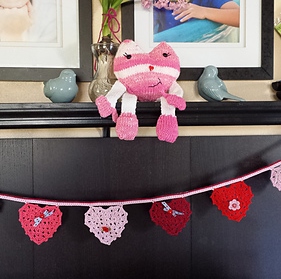
More lovelies from last year’s swap:
Come join us – you know you want to! 😉
Dear Knitters,
I am so excited that we’re going to have another Wuv, Tru Wuv Mini Swap in my Ravelry Group! You can read all about the 2016 Valentine’s Day Mini Swap here.
And wuv, tru wuv, will fowow you foweva…
…from The Princess Bride
The rules for this swap are easy:
Sign-ups are here. Don’t miss out: Sign up before January 4th!
All of 2016’s wonderful Wuv, Tru Wuv swap gifts:
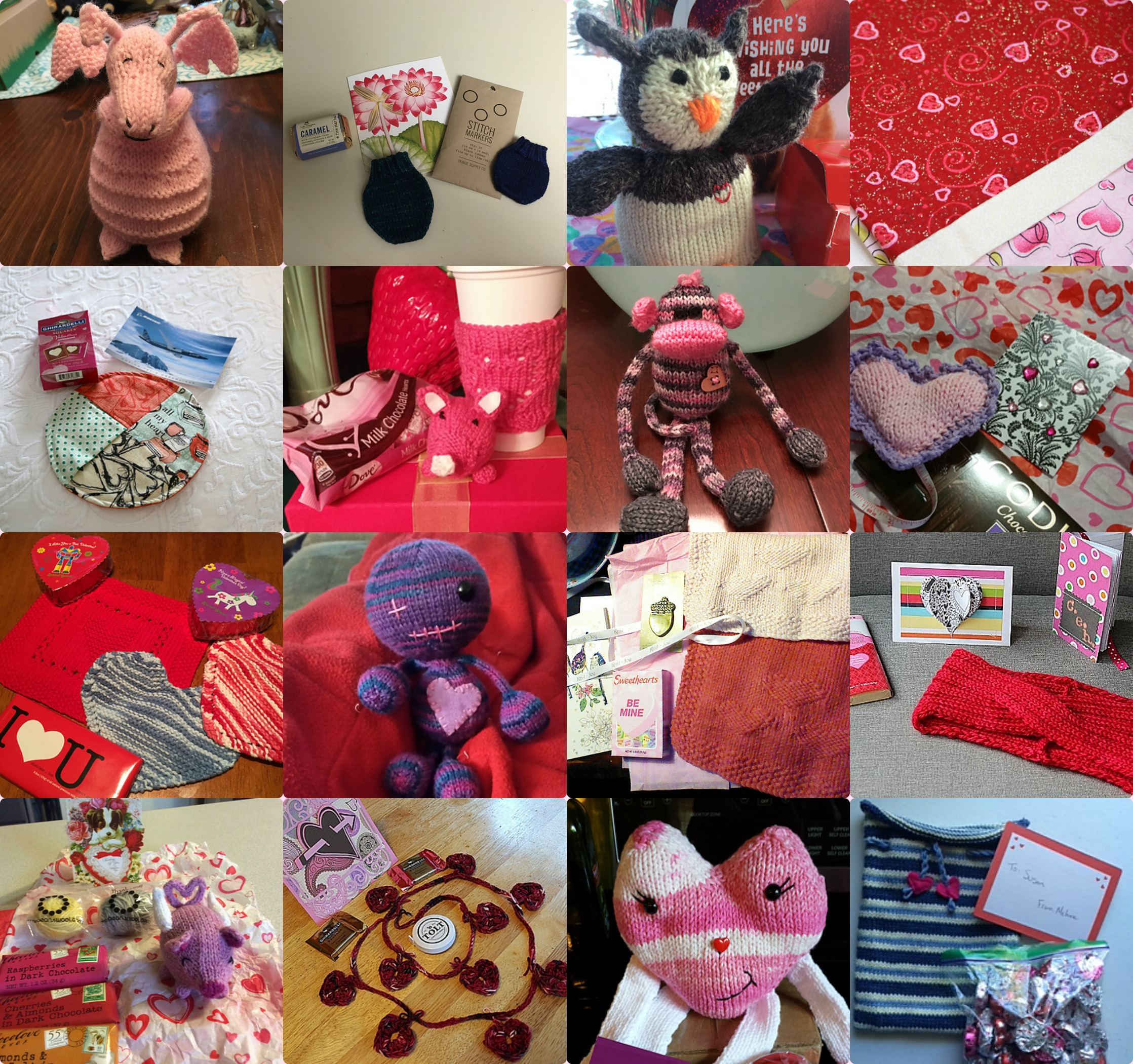
Wanna be a knit equals joy swapper? Come on over to the group and join us!
There are two new knitters in my family, my sister and my cousin’s daughter-in-law. My cousin asked me last week if I had any advice for her DIL, which led to my thinking about this post.
If you are new to knitting, there are some things you can do that will help you to continue to love knitting and will help you move from that very beginning awkwardness where you feel you’re all fingers to being able to create all those lovely and beautiful things that you will be able to make!
Choose the best yarn you can afford, even at the beginning*. There are so many beautiful yarns available now. Part of the joy of knitting is working with a yarn that is soft and squishy and/or is in a color that you love. Try to find a local yarn shop (LYS) –they can provide expertise and support, and often offer helpful knitting classes in a variety of techniques.
Find a fiber that you like.
Wool is always wonderful and is perfect for beginners. If possible, buy your first yarn in person so that you can touch it, squeeze it, hold it next to your face. (Go to a yarn shop – you will see people doing these things. It will cease to surprise you and will become commonplace.)
Do you love alpaca, silk, or cashmere? Those fibers are absolutely delectable, and, for your first project, if you can find them in a blend with wool, you will have a yarn that is a bit easier to work with (or perhaps I should just say is more predictable) than the fiber alone. And that leads me to the next bit of advice…
That’s right. Say you read my piece of advice above but found some 100% alpaca you want to knit with. You love the yarn – go for it!!! You will learn about how different fibers work by actually working with them. It’s a fun way to learn.
Besides, if you don’t like something, you can rip it out and start over with something new. You still have your raw materials and, while you may have spent time on that knitting, I bet that you learned something as you were knitting – about that particular yarn, stitch, or technique… Well, you get my point: the time spent knitting wasn’t wasted, even if you have to rip out your knitting.
Speaking of learning, there are also some terrific books, and that leads us to…
There are lots of great pattern books as well as books on the history of knitting and the history of different types of knitting like Estonian Lace or Fair Isle colorwork. Knitting magazines like Vogue Knitting are a great resource for inspiration, patterns, and knitting techniques.
Books I recommend:
Stitch ‘n Bitch: The Knitter’s Handbook by Debbie Stoller. This is really a perfect book for a beginning knitter, as it covers all the basics, from needles and yarns to techniques. I love this book for its section on how to fix mistakes. This book quite literally saved me hours of reknitting. Before reading this book, I did not know that you don’t have to rip out rows and rows of knitting to fix a dropped stitch. Worth the price of the book right there!
The Knitter’s Book of Yarn: The Ultimate Guide to Choosing, Using, and Enjoying Yarn by Clara Parkes. This book is a fun read and will give you a good understanding of how different fibers will behave.
Ravelry is basically a social networking site for knitters and other fiber enthusiasts. It is also a huge database of patterns, yarns and projects. Ravelry is a member-based site. It doesn’t cost anything to join, but you do have to sign up. Then you will have access to the database and can do as much or as little of the social part as you like.
While there is a ton to explore on Ravelry, as a beginning knitter I found two aspects to be extremely helpful.
Pattern database.
Pick a pattern, any pattern. Odds are that it’s on Ravelry and that someone else has made it. You can look at the Ravelry pattern page to find out helpful information like needle size, what yarn is recommended and in what quantity. This is very helpful when you are in the yarn shop and want to know how much yarn to buy.
The other thing that Ravelry does that is brilliant and helpful is to let people link their projects to the pattern page. This means that you can see what they made, what yarns and needles they used, and any comments they might have about the pattern or their finished item.
Here is a link to the Ravelry page for one of my patterns, Passport Mitts. And here you can see all the projects by other knitters: Passport Mitts Project Pages.
Try to find patterns that are well-written – and I’ll write about what a well-written pattern should include in an upcoming blog post.
Yarn database.
Say you buy a new yarn. It’s really pretty, but you’re not sure what to make with it. Ravelry’s database to the rescue again! Go to the yarn tab, enter that yarn, and it will pull up all of the projects made in that yarn. Pretty cool, huh? Yarn database.
My knitting skills really increased during the Tour de Fleece years ago (takes place during the Tour de France), when we were challenged to knit half an hour each day. It will help to build muscle memory and you will lose that feeling of being all fingers.
Make knitting your craft. Knit the things you want to knit. Tackle things you want to when you want to, regardless of whether they seem too easy or too hard or don’t seem to fit in with what someone else has told you that you should do.
I made nothing but scarves for the first year or two that I knitted. Everyone got scarves for Christmas. Then, when I was ready, I branched out to new patterns, techniques, and projects.
If I had to narrow this advice down to a few soundbites, it would be this: find yarn you love, find other knitters to support you and help you with the technical stuff, knit a little every day if you can, and make what you want to make.
I wish you the best and I hope that your knitting will bring you joy as you make beautiful and useful things! If you know a new knitter who would benefit from this advice, please share!
*I gleaned this piece of advice from the book Itty Bitty Hats by Susan B. Anderson when I was a very new knitter. I think it was the best knitting advice I ever received. Susan now has her own yarn company, Barrett Wool Co., where you can find excellent yarn. I used it for my Wintry Blue PepperMitts.